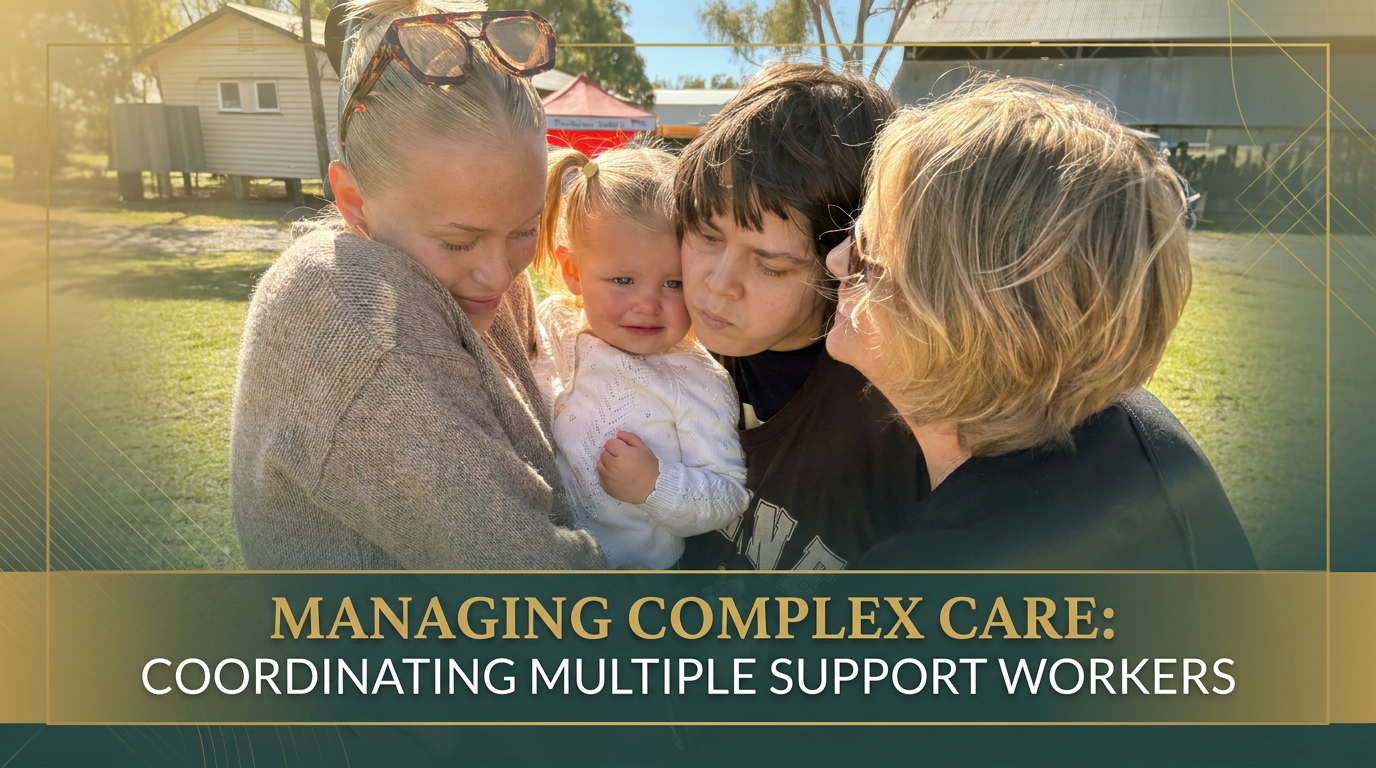
You're coordinating care for someone you love. There's the morning support worker who knows their routine. The afternoon carer who handles medication. The weekend staff member who covers respite. The educator who's tracking progress at school. The physiotherapist who comes twice a week.
Everyone means well. Everyone has good intentions. But when care knowledge is scattered across five different people, five different notebooks, and five different communication channels, something inevitably falls through the cracks.
A seizure happens on Tuesday, but the new weekend carer doesn't know about it. A medication change is made on Monday, but the afternoon support worker doesn't see it. A behaviour pattern emerges over weeks, but no one has the full picture because each carer only sees their shift.
This is the reality of managing complex care across multiple support workers — and it's one of the most stressful parts of being a family member or care coordinator.
Here's what you need to know: your current system isn't broken — it's fundamentally insufficient. Notebooks, messages, and handover forms feel like solutions, but they're band-aids on a system that was never designed to handle complexity.
There is a better way. Let's talk about why manual systems fail, and what an NDIA-registered app designed for complex care coordination can actually achieve.
The Problem: Why Notebooks and Messages Always Fail
You've probably tried some version of this: a handover notebook at the care location, text message updates, group chats, printed care plans, sticky notes on the fridge. These feel like you're managing things. But they're not actually solving your problem.
1. Information is scattered and inaccessible
Each carer keeps notes in their own place — or doesn't keep them at all. One uses a physical notebook at the care location. Another jots observations on sticky notes. A third keeps everything in their head. A fourth relies on your text messages. When someone is sick, on leave, or switches shifts, that information is simply gone.
You spend hours trying to reconstruct what happened: Was that seizure last Tuesday or Wednesday? Did the medication change happen two weeks ago or three? How many times this month did they refuse their meal? When you ask carers, they can't remember. The information exists somewhere, but it's locked in five different places.
Result: You're constantly hunting for information that should be immediately available. You make care decisions without complete information because the information is too hard to gather.
2. Messages and notebooks aren't searchable — pattern recognition is impossible
You have a crucial question: "Has the behaviour improved since we adjusted the routine three weeks ago?" To answer it with messages, you're scrolling through endless threads trying to find relevant entries. With notebooks, you're manually flipping through pages. With sticky notes, you're hoping you haven't thrown anything away. It takes time. You often miss things. You rarely do it thoroughly, so you never actually see the patterns.
And here's the consequence: you miss the insights that could transform care. You never see that "She's always worse on Fridays," or "His seizures cluster after he skips meals," or "Behaviour improves when this specific carer is present." These insights would guide your decisions, prevent incidents, and reduce stress. But with scattered notes, you don't have time to look for them, so you keep repeating the same problems without understanding why.
Result: You're reactive instead of proactive. You're managing crises instead of preventing them.
3. They create accountability gaps and compliance nightmares
When something goes wrong — a dose is missed, a seizure isn't logged, an incident isn't reported — no one is quite sure who was responsible. The information fell through the gap between shifts, or it was communicated verbally and forgotten, or it was in someone's notebook but never shared. Blame becomes unclear.
But accountability matters. If you're a provider operating under NDIS requirements, regulators need timestamped evidence that care plans are actually being followed. A notebook can't prove what happened at 3 PM on Tuesday. A scattered message thread can, but only if you save every message and remember to search through it — which you won't, because there are hundreds. When an auditor asks, "How do you know this care plan is being followed?" you're pulling together scraps, hoping you've documented enough. You're not confident. You can't easily show that medication was given consistently, that observations were recorded, that decisions were documented properly.
Result: NDIS compliance becomes a nightmare. You're reactive, creating documentation after problems, instead of having a clear audit trail that shows care was always managed intentionally.
4. Families become the information hub — and burn out
Someone has to keep everyone in sync. So you do it. You're texting carers about the seizure you noticed. You're calling about the medication change. You're emailing the educator about the behaviour pattern. You're the translator, the repeater, the person who has to manually sync everyone to the same reality.
This is not transparency. This is emotional labour disguised as coordination. And it burns families out. You're working a second job just to make sure your care team is informed.
Result: Families are exhausted. Carers are frustrated because they have to chase you for information. The person receiving care doesn't get the consistent, intentional support they deserve because the system depends entirely on one person's capacity.
The Truth About Manual Systems
Here's the honest assessment: notebooks, messages, handover forms, and spreadsheets were never designed for complex care coordination. They're not adequate. They're not going to work, no matter how disciplined your team is or how good your intentions are.
You can't overcome a broken system through willpower.
The system is broken because:
- Scattered information can't be accessed quickly → carers make decisions without full knowledge
- Information that's hard to search can't reveal patterns → you miss the insights that prevent incidents
- Manual documentation creates gaps and inconsistencies → accountability becomes unclear
- Families become the coordination hub → families burn out and care quality suffers
- There's no audit trail → NDIS compliance is impossible to prove
You need a different approach entirely.
The Solution: A Purpose-Built App to Manage Complex Care
What you actually need is a system designed specifically for complex care coordination. Not a notebook. Not a spreadsheet. Not text messages. A purpose-built app designed to solve these exact problems.
A purpose-built app to manage complex care — like My Day My Way® — replaces every scattered system with one unified place where care actually gets managed.
Here's how it solves every problem:
Real-time visibility — no more scattered information
Every carer logs observations from their shift in one place. When the next shift starts, all the information is there — immediately accessible. No hunting through notebooks. No texting families to ask what happened. No relying on memory.
A new carer taking their first shift? They open the app and see the full care history. They see the medication schedule. They see recent incidents. They see patterns. They're not guessing. They're informed.
Reminders + timestamping = no missed doses, complete accountability
Here's where an app designed for care management becomes truly powerful for medication management: it combines two features that notebooks simply can't match.
First, reminders. When medication is due, the carer gets a notification. They don't rely on memory or a handwritten schedule that might be incomplete. The reminder happens at the right time.
Second, automatic timestamping and attribution. When the carer logs the medication in the app, it records exactly when it was given and who administered it. No more "meds given sometime today." You have: "Medication X given at 9:15 AM by Sarah on March 15th." That's not just documentation — that's proof of compliance.
The carer can add notes in their own words — any reactions, concerns, or observations — but the critical information is captured automatically. No more missed doses. No more guessing about what happened when. No more accountability gaps when an auditor asks for evidence that the care plan was followed. The app has the complete record built in.
Pattern recognition becomes possible
Because all information is in one place and organized by date, patterns become visible. You don't have to manually flip through weeks of scattered notes and messages. You can actually read back through the care record and see:
- How many seizures happened this week vs. last week
- What times incidents cluster around
- Whether behaviour improved after the routine change
- Which support worker's shifts seem to go more smoothly
- Correlation between medication changes and sleep quality
- The notes and details you recorded that help you understand why
The free text entries capture the full context — the nuance and detail that numbers alone can't show. You see the patterns and understand them. You become proactive instead of reactive.
Timestamped, attributed entries create accountability and compliance
Every entry is timestamped and attributed to the person who created it. There's no guessing about who documented what or when it happened. If a dose was given, there's a record of it. If it wasn't, that gap is visible. If an incident happened, it's logged with details. If a pattern emerged, it's documented.
When an NDIS auditor asks, "How do you know this care plan is being followed?" you don't hunt through scattered notes. You show them the app. You show them the timeline. You show them the evidence. You're confident because the evidence is right there.
Families get real visibility without being the hub
Families can see what's happening in their loved one's care in real time. They don't have to text carers and wait for responses. They don't have to chase information. They're not the coordination hub anymore. They can see:
- What medications were given today
- What support workers are present and when
- Recent incidents and how they were handled
- Progress toward care plan goals
- Any changes to routine
They have the transparency they need without the emotional labour of chasing information. They get peace of mind.
Real Examples: How My Day My Way® Solves Complex Care
Scenario 1: The medication change that didn't get passed on (and the dose that wasn't given)
Without an app: Monday morning, the doctor prescribes a new medication. You text the afternoon carer. You text the weekend staff. You email the educator. You call the physiotherapist. One carer doesn't see the message. The medication isn't given on Tuesday afternoon because they forgot — no reminder, and it wasn't written in the notebook where they check. You don't find out until Thursday. When the auditor asks months later whether the medication was given consistently, you're scrambling to reconstruct what happened.
With My Day My Way®: The medication is logged in the app on Monday morning. Every person on the care team sees it immediately. When Tuesday afternoon arrives, the system sends a reminder to the carer. They log it in the app at 2:30 PM — timestamped, with their name attached. The medication is tracked. When the auditor asks six months later about adherence, you pull up the app. You have a complete record: every dose given, exact times, who administered it. You're confident in the evidence.
Scenario 2: The behaviour pattern no one could see
Without an app: You notice that incidents seem to cluster on certain days, but you're not sure. You ask carers, but they only see their own shifts. You have notebooks and messages scattered everywhere, so you can't easily look back. You can't find the pattern. You keep dealing with the same crisis week after week.
With My Day My Way®: Every incident is logged with the time, trigger, outcome, and carer present. The app shows you a clear timeline. You see immediately that incidents spike on Fridays. You dig deeper and see it's always in the afternoon. You realize it correlates with a specific activity. You change the activity. Incidents drop. You've solved a problem that was invisible before.
Scenario 3: The new carer's knowledge gap
Without an app: A relief carer shows up for their first shift. They're given a handover note, but it's incomplete. They don't know about the sensitivity to loud noises, so an incident happens. They don't know about the preferred routine, so everything feels off. They're unprepared.
With My Day My Way®: The new carer logs in. They see the full care history. They see the notes about sensory sensitivities. They see the preferred routine. They see recent incidents and how they were handled. They see what medications are due. They're prepared. They can provide consistent care because they have complete information.
Scenario 4: NDIS auditor confidence
Without an app: The auditor asks for evidence that care plans are being followed. You pull together scattered documentation — some from notebooks, some from messages, some from memory. There are gaps. The documentation is inconsistent. You're not confident the evidence is complete. The auditor has doubts.
With My Day My Way®: The auditor asks the same question. You show them the app. Every care entry is timestamped. Every medication administration is logged. Every incident is documented. Every decision is recorded. You have a complete audit trail that shows care was managed intentionally and consistently. The auditor is confident.
Why My Day My Way® Is Different
My Day My Way® isn't just another tool. It's built specifically for NDIS care coordination by people who understand the sector deeply.
What makes it the right solution:
- NDIA-registered — officially recognized by the NDIA in two categories: Assistive products for personal care and safety, and Communications and information equipment. This proves it's not just compliant — it's officially validated as fit-for-purpose in the NDIS ecosystem
- Built for NDIS teams — it understands the regulatory requirements and documentation standards that matter to you
- Medication reminders built in — carers get notified when medication is due, eliminating missed doses and memory gaps
- Timestamped and attributed entries — every medication administration is recorded with the exact time and who gave it — proof of compliance, built automatically
- Guided prompts, flexible free text — helpful reminders so you capture what matters (observations, reactions, concerns) in your own words, not rigid forms
- Real-time and mobile-friendly — carers log information from their phones during or immediately after shifts, not hours later from a desk
- Everything organized and searchable — all the care notes are in one place, organized by date, so you can actually find what happened and see patterns
- Family visibility without families being the hub — the person you love gets seen, and you get peace of mind, without you having to manage everyone's information
- Australian-built, NDIS-ready — built on Australian infrastructure, compliant with Australian regulations, designed for Australian providers
You don't need a complicated enterprise tool. You don't need to choose between scattered notebooks and overwhelming complexity. You need a purpose-built app that solves your actual problem: keeping your care team in sync, seeing patterns, and proving you're doing the right thing.
What Happens Next
If you're managing complex care with multiple support workers, your current system is failing you. Notebooks and messages and handover forms are not going to fix that.
You have two choices:
- Keep struggling with a broken system. Keep being the coordination hub. Keep missing patterns. Keep hoping your NDIS documentation is good enough.
- Move to a system actually designed to manage complex care. Stop being the hub. See the patterns. Build a complete audit trail. Get real visibility. Give your care team access to the information they need.
The second option isn't just easier. It results in better care.
See how My Day My Way® — NDIA-registered, purpose-built for complex care coordination — brings your care team together with real-time visibility, pattern recognition, NDIS-ready documentation, and family peace of mind.
Start your free trial and see what it's like to manage complex care the way it should be managed.